
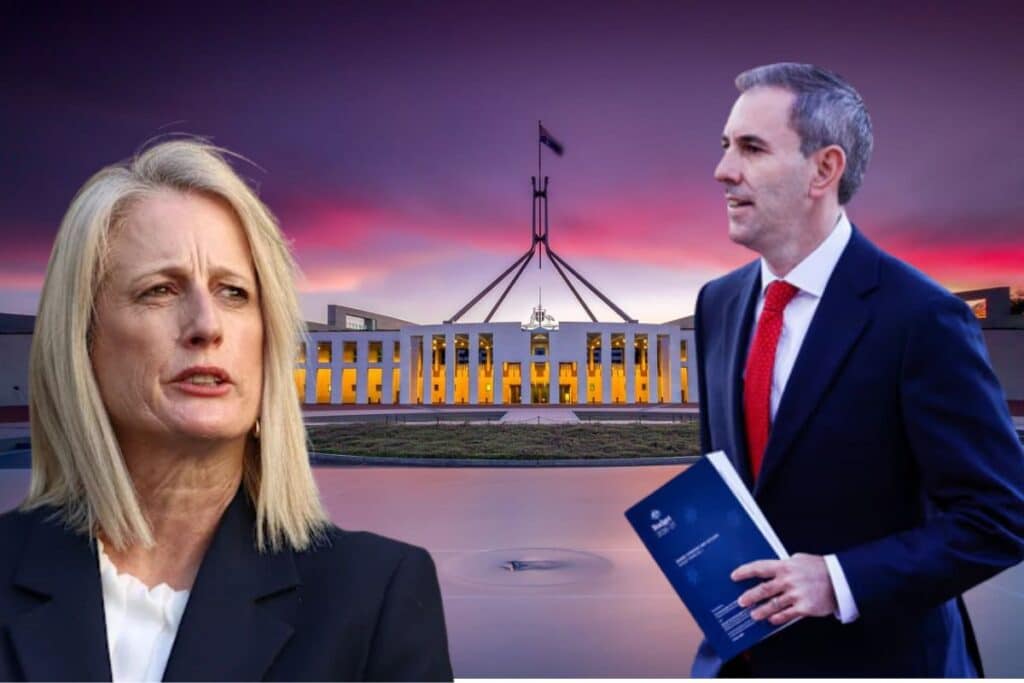
A document called the Women’s Budget Statement should tell us how the Budget affects women. What the Albanese Government’s fifth such statement offers is how a small portion of the Budget affects women.
While the Statement, once again, does a good job outlining the key figures on gender pay, leadership, and safety gaps, the funding measures outlined are not enough to address even a fraction of the extent of such challenges — especially on women’s safety.
To be clear, the Albanese Government should be commended for publishing such statements for five years now, after such gendered analysis was completely abandoned by previous Liberal governments. These statements do capture a record of the gender gaps Australia faces, which are further widened for First Nations women.
But it’s fair to raise questions about these statements if they’re being used to outline success against pretty low, basic benchmarks.
This year’s statement repackages existing announcements, gives prominence to smaller initiatives that are a little more interesting or novel, and applies some basic gendered analysis. The new Working Australians Tax Offset, worth up to $250 a year, is accompanied by a note that 6.3 million women will benefit. Spending more likely to affect women, such as the ban on non-compete clauses for low- and middle-income workers, is explicitly framed as a gender measure.
But there is little to no scrutiny of the larger spending initiatives that aren’t expressly gender-based and yet carry a significant gendered impact. And much of the statement is concerned with spending, arguably not a woman’s issue at all – for example, the $1 billion to make personal care free under Support at Home.
There is no gender analysis published on NDIS reform that will divert 160,000 participants to Thriving Kids by 2030, which will carry enormous implications for women who are the majority of carers. There is no analysis of the broader productivity package outlined, nor the additional $53 billion allocated for defence spending.
The Government cannot use the statement to highlight how it’s making things safer for women, given there is very little in it that will help achieve such safety.
The response to the crisis of domestic and family violence is especially concerning.
Much of the investment outlined for women’s safety and domestic violence is simply a repackaging of existing funding announcements. The exceptions are the $182.6 million reform to the Child Support Scheme, and $218.3 million over five years to support initial work on the First Nations plan to end family, domestic and sexual violence.
Nor does the statement address the other fast-emerging issues now damaging the already fragile progress made on gender equality, including climate change and the impact of AI on labour markets, with female-dominated occupations among the most exposed to automation.
The Treasurer mentioned women four times during his Budget speech on Tuesday night. He noted that the Albanese Government has backed $21 billion in wage rises for women working in sectors like aged care, which he said have been undervalued for too long. He also highlighted $4.4 billion in existing funding for the National Plan to End Violence against Women since 2022, as well as “hundreds of millions of dollars for front-line services.”

Sector leaders are warning that the investment does not match the scale of the crisis, and that cost-of-living relief packages fail to recognise the inevitable uptick in violence that comes during periods of financial stress.”
The Budget was handed down on the same day DVNSW announced a 49 per cent uptick in “high risk” referrals to services by NSW police, with DVNSW believing economic stress on households, as well as isolation, are two factors contributing.
“Every budget is an expression of what a government values,” said No to Violence CEO Phillip Ripper. “For women and children trapped in violent homes, tonight’s budget offers them no relief. This Government has chosen tinkering at the edges over the serious investment needed to stop violence before it escalates.”
Adrianne Walters, Executive Director of Women’s Legal Services Australia, welcomed the child support reform but warned about what’s missing.
“With rising inflation and fuel costs, the risks of violence against women in their homes grow. At the same time, the costs of delivering services, especially vital outreach services, are also growing. Our services are already forced to turn away around 1,000 women a week. Each woman turned away is more exposed to violence, more likely to face long-term economic hardship.”
And it’s clear, according to figures outlined in the Treasurer’s own Women’s Budget Statement, that older women face key challenges to economic security. As Yumi Lee from Older Women Network outlined in her Budget responses, the gender pay gap peaks at 29.6% for women aged 40 to 54, and outcomes are worsening for women aged 55 and over.
“The women who raised children, did unpaid care, took career breaks, worked part time, missed promotions, re-entered the workforce at a disadvantage, and carried the cumulative cost of a system that was never designed around their lives continue to be forgotten,” Lee wrote. She welcomed the announced changes but noted they are designed to support women with decades of work ahead of them.
The Albanese Government is ready to take on a fight regarding intergenerational wealth inequality. It’s issued changes to negative gearing that are much-needed and could make a considerable difference to inequality in the future. It was a bold and welcome take — and one they’ll likely be answering tough questions over until the next election.
The Treasurer described a “defining motivation” of his Budget as being “the fair go, a defining characteristic of future generations, as much as for older generations.”
But my concern is what’s missing for women facing safety and economic security risks right now — and the additional gender implications of what’s coming ahead.
The “fair go” for those future generations carries plenty of risk, especially in the context of climate change and AI labour disruptions. There’s only so far that future housing affordability can go.
“Climate change” didn’t rate a single mention in the Treasurer’s speech, nor much of anything in the full budget, nor is it mentioned in the Women’s Budget Statement. The Climate Council has described the Budget as a free kick to fossil fuels, pointing to $19 billion in annual fossil fuel subsidies and forgone gas tax revenue that will be maintained. The Australian Conservation Foundation calculates the Budget features at least seven times more spending on initiatives that damage nature and the climate than it allocates to climate and nature protection.
The challenges facing women are not behind us, despite the Albanese Government’s genuine progress on the gender pay gap, workforce participation and political representation during its one-and-a-half terms
If anything, as we’ve seen globally, things are set to get more challenging for women and girls. Publishing a Women’s Budget Statement remains welcome, but the Albanese Government can’t gloss over serious issues about how women are faring by repackaging existing spending, outlining some additional small funding measures, and cherry-picking which costings receive a gendered analysis that is outlined in the Statement.