
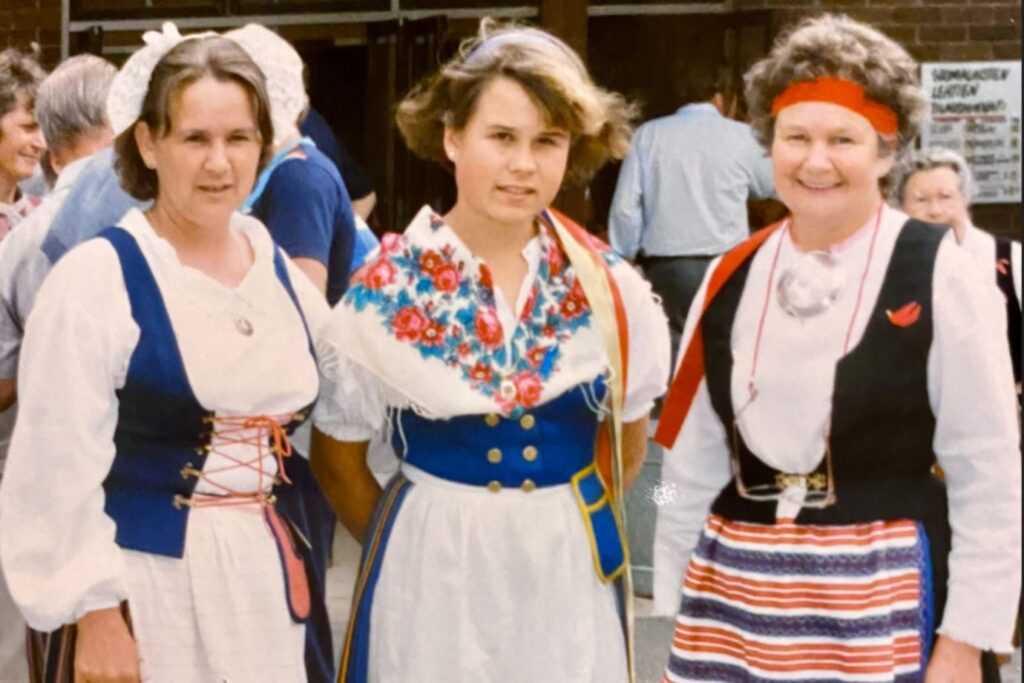
I am the granddaughter of migrants. I’ve spent a decade building a company that has put more than 400 women and First Nations leaders on the path to senior leadership. And right now, I am watching my country argue about whether people like my grandparents should have been let in.
My name is Katriina Tähkä. The umlaut is Finnish.
My grandparents were too. They fled post-war Finland, a small, cold country at the top of Europe that most Australians in the 1950s could not have found on a map. There was no “happiest country in the world” branding. There was no “world-leading education system” reputation. There were two young people who made the decision to leave everything they knew and come to the other side of the world, because Australia was a country that still talked about the fair go like it meant something. They came to create a better life, not for themselves, but for the generations after them.
I want to be honest about what happened next, because the version of migration history currently being sold in this country leaves out almost all of it.
My grandparents arrived with nothing. They were sent to Bonegilla – the migrant reception centre in rural Victoria where thousands of post-war arrivals were housed while Australia decided what to do with them. They were called names on the street. They were spat at. They learned English the hard way, in a country that did not always feel especially patient about teaching it to them. They worked the kinds of jobs that the locally-born did not want, and they raised their children here.
My parents were those children. They went to Australian schools. They grew up in this country. They met here, married here, and had me here. I was born in Australia. And I went to a school called Willoughby Girls High in Sydney, a school that the kids at the school near by used to call Wogloughby Girls High, because that is what you called girls with surnames like mine in the Australia of my childhood.
I was a wog. That is the word that was used. I was the Australian-born granddaughter of Finnish migrants, a white girl with an unusual surname and a packed lunch that occasionally contained rye bread, and that was enough to stand out as different. Three generations in, and still not quite right. The category of acceptable Australian was narrower then, and we were still outside it, and we knew it.
I am telling you this because there is a particular argument going around right now that I want to address directly. The argument is that some migrants are good migrants, the ones from “liberal democracies,” the ones whose values are pre-approved, the ones who supposedly slot in without friction; and that the rest are something else. And the people making this argument will look at someone like me, today, in 2026, with a law degree and a board seat and a successful business, and they will say: see, the system worked for her. She came from the right kind of place. There was no struggle. Her whiteness did the work.
I want to be very careful here, because part of that sentence is true and part of it is a lie, and the difference between the two is the entire point of this piece.
It is true that today, in 2026, I move through Australian corporate life with privileges that many migrants and almost all First Nations Australians do not have. My skin colour does not announce my difference before I open my mouth. My accent is indistinguishable from any other Sydney lawyer’s. I can choose, on any given day, not to stand out and that choice is itself a form of privilege I will not pretend I do not have. I see it. I am not blind to it.
But it is a lie that the path I now walk was paved by my whiteness alone, or that my family’s “fitting in” was free.
It was not free. It was paid for. It was paid for across three generations of grinding, daily, often humiliating integration work. The migrant camp at Bonegilla, the spitting on the street, the wogs in the playground, the surname my grandmother eventually learned to spell aloud, slowly, every single time she introduced herself for the rest of her life. The reason I can now move easily through Australian boardrooms is not that the doors were open to people who looked like me. It is that two generations of my family did the back-breaking work of squeezing through doors that were barely ajar, and held them open with their shoulders so I could walk through standing up.
The “good migrant from a liberal democracy” frame is not a description of history. It is a rewrite of history. It airbrushes out the camps and the slurs and the playgrounds, and it pretends that the fair go was extended freely, when in fact it was extracted – slowly, painfully, across decades – and only after the first wave of arrivals had agreed to disappear into the background of the country they had joined.
I got very good at disappearing. I went into law, which rewards people who can blend. I went into corporate HR, which rewards them more. I learned to dress like the partners, talk like the partners, and never bring up my Finnish family unless it was a mildly amusing anecdote at the Christmas drinks. I was the safe Finn. The undisruptive one. The one whose difference was decorative rather than structural. And it worked. I climbed. I was rewarded. I was held up as a success story.
And somewhere around the middle of my career, I realised that the entire success had been built on a single load-bearing transaction. I had agreed, without ever quite saying so out loud, that the price of belonging in Australian corporate life was making sure nobody had to think about where I came from.
That is the deal “blending in” actually offers. It is the deal that was offered to my grandparents’ generation, and quietly accepted. It is the deal that has been offered to every wave of migrants who have built this country. And it is the deal that the people now arguing for “values-based” migration are preparing to offer to the next generation of migrant kids, in a louder and uglier register than any version of it I have heard in my lifetime.
I am not willing to let them.