
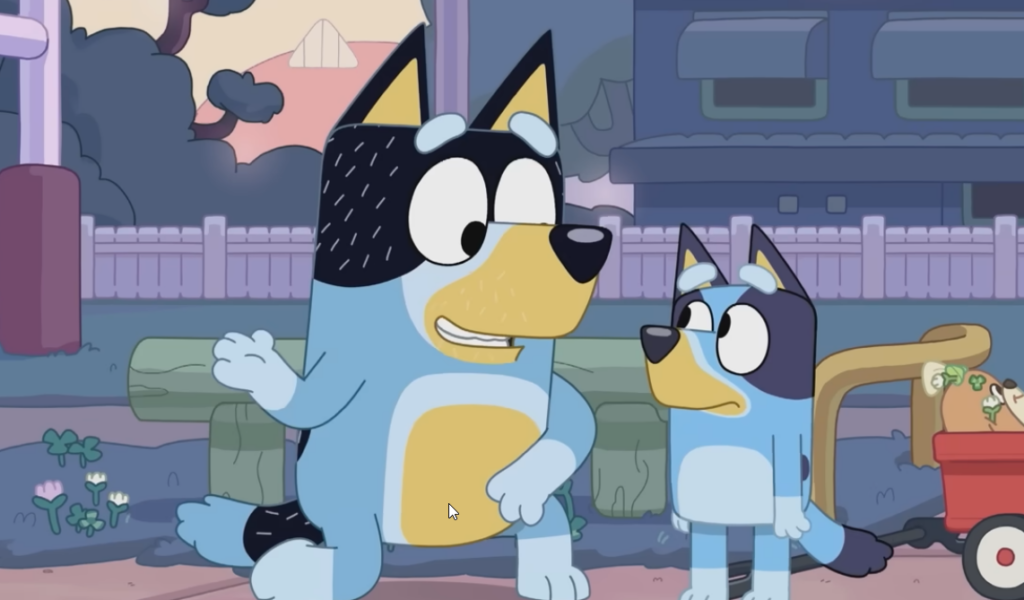
I’m not a monster. I love Bluey as much as the next millennial parent and kid under ten.
The hangover episode still makes me laugh even after watching it approximately 407 times.
More broadly, the show is beautifully made, iconically Aussie and somehow manages to capture the chaos of family life without ever feeling saccharine.
But, and I’ve been reluctant to admit this, sometimes watching Bluey with my kids makes me sad.
Not because there is anything wrong with Bluey. There really isn’t. In fact, part of the reason it gets to me is because it is so good at depicting the small, ordinary pleasures of family life.
Bluey and Bingo have Mum and Dad, and Bandit and Chilli are deeply woven through almost every episode. They play, make each other laugh, annoy each other, tag-team the parenting and occasionally get five minutes to themselves. They are partners as well as parents, and the show is full of those tiny, heartfelt moments.
But while the family dynamics in Bluey are unflawed, they are also totally foreign to thousands of kids watching it.
This isn’t unique to Bluey. If you spend as much time watching preschool TV as I do (yes, yes terrible parent), you’ll notice how often the mum-and-dad family is treated as the default setting.
There’s Mummy Pig and Daddy Pig in Peppa Pig. Daniel Tiger has a mum and dad. Kangaroo Beach, another Australian favourite, has a cast of characters whose family lives are generally presented through similarly familiar structures.
There are definitely shows that portray different family make ups, and we’re getting way better at presenting different cultures, abilities and backgrounds. But when you consider the volume of books and TV that kids consume, the happy, hetero nuclear family remains persistently dominant.
And obviously, as a single mum, I’m more cognisant than ever.
My four-year-old watches Bluey completely absorbed, laughing so hard that she sometimes misses the next line. She isn’t sitting there thinking about family structures. But occasionally, I find myself wondering whether there is a tiny thought somewhere in her head asking why her family doesn’t look like Bluey’s.

I don’t know if there is. I may be projecting my own feelings onto her, and I certainly don’t want to turn every moment of screen time into an exercise in analysing what my kids might be missing.
But it would also be silly to assume that kids are blind. Of course, they notice things, and they notice them much earlier than we sometimes assume.
They notice who has a mum and dad or who lives with whom. They notice when their friend’s dad picks them up from school or coaches their soccer, or when another family goes on holiday together.
My kids know their family looks different. And while I don’t think they’re bogged down in the worry and anxiety of it, I have to admit that I sometimes am.
I know rationally that my kids aren’t missing a family; they have one. They have a loving, chaotic, busy family full of people who adore them. But it doesn’t look like Bluey’s.
Australia has close to one million single-mother families, making up roughly 12 to 13 per cent of families across the country. Australian Bureau of Statistics projections suggest female lone-parent families will remain at around 13 to 14 per cent of all families through to 2046, while the number of single-father families is projected to grow at a faster rate too.
It makes me wonder why stories about single parenting aren’t simply more commonplace.
I’m not talking about making every kids’ book or show explicitly about separation, divorce or the challenges of being raised by one parent. But I’d love to see stories in which a single-parent family is just… a family.
A kid growing up with one parent should be able to open a book or turn on the box and see a family that looks like theirs without the story needing to tell them that their family is unusual, deficient or a little bit incomplete, just as much as a kid growing up with two parents should see that their family isn’t the only possible version of normal.
I don’t want less Bluey. I just want more stories.
More books, more shows, more families that look different from the nuclear ideal and are still allowed to be funny, loving, complicated and completely ordinary. That matters to the growing number of Australian kids being raised by one parent, like mine.
It matters to their parents too.