
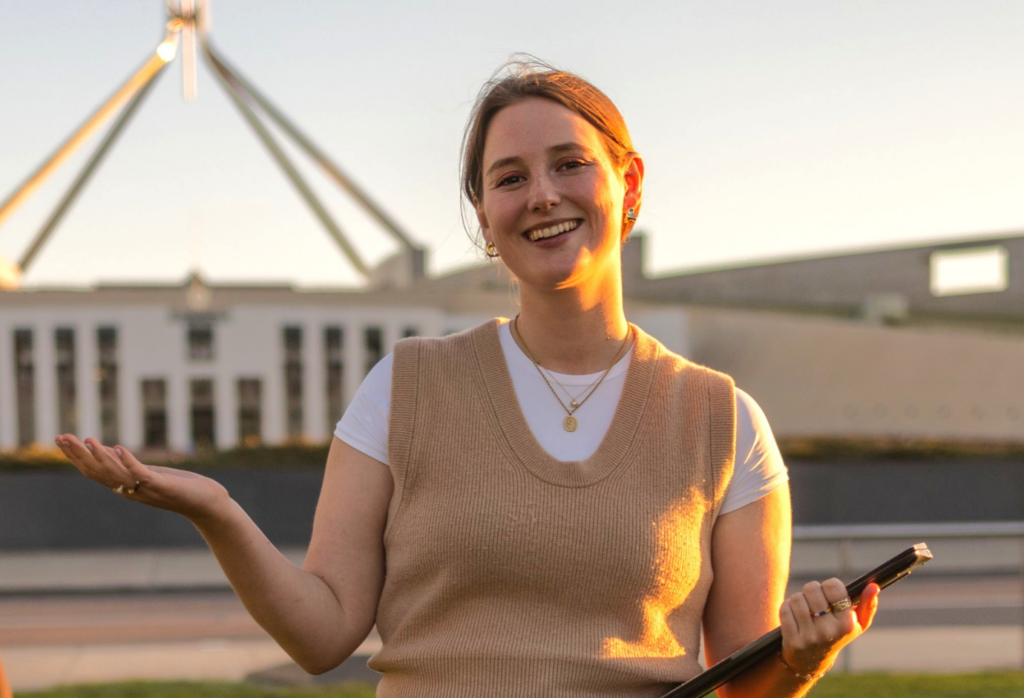
When Lucy Skelton ran for State Parliament in 2022, she was finishing a degree in public policy and spending her spare time discussing politics over pizza with fellow students. Having spent almost a decade in advocacy, she was passionate about ensuring more young people had a voice in shaping public policy.
It was a landmark period for the Melbourne local. At just 20, Skelton became the youngest candidate in the 2024 Victorian election, running for the seat of Kew.
After years observing how federal parliament operates, Skelton noticed a recurring problem: comprehensive, meticulously researched reports were landing on ministers’ desks only to go unread.
“Not because they weren’t good, and not because the office was evil, but simply because the volume of material that comes across a politician’s desk every week makes it impossible to get through it all,” she told Women’s Agenda.
“These big, beautiful, meticulously researched reports just end up on desks unread.”
Skelton, a 2026 Vic Young Australian of the Year Nominee, mulled over an idea: what if an independent, third-party resource did the work of meeting with experts, cataloguing what they were calling for, and presenting those ideas in formats that decision-makers could actually use?
“Australia doesn’t have a shortage of solutions — we have a shortage of those solutions being seen by the right people at the right time, in formats they can use,” she said.
At some point, Skelton said, she realised that if she ever stood in front of a minister, she would only have slogans.
“I knew from experience that you need to be specific,” she said. “Instead of saying ‘We want stronger environment laws,’ You need to be able to say: ‘Are we talking about the EPBC Act? A new trigger? Funding changes?’ If I’d been in these spaces for years and still couldn’t get specific, who else couldn’t? How many opportunities were we missing?”
Skelton turned these questions into her own non-partisan not for profit initiative, FORE Good, where academics, NGOs, peak bodies and people with lived experience collaborate to catalogue expert-led policy ideas into a central online resource of one-page briefs.
FORE’s Policy Library is designed for public servants, staffers and politicians, distilling complex ideas into clear, comparable briefs. The organisation also runs large-scale, inclusive training programs that shed light on practical policy experience while contributing to a national resource designed to support evidence-based decision-making.
The effort was monumental — especially around collecting all the content itself.
“I initially assumed the experts would draft the policy briefs, and I quickly realised that not only did many of them not have time — they often didn’t know how. It would take me just as long to reformat their work anyway,” Skelton recounts. “So we brought everything in-house, which meant training people.”
Skelton and her team posted a volunteer listing on Ethical Jobs looking for single policy position, and ended up receiving over 60 applications. She decided to accept them all.
“The more people who have access to these skills, the better, no matter where they go next,” she explains. We loved it — the national reach, the virtual format, the big collaborative cohorts — and it’s become our model ever since. In our most recent summer cohort, we had over 300 applicants and accepted more than 100 people into the program.”
Skelton calls her approach a dual-impact model: building a policy library while providing a training ground for young people to learn how policy works.
Her animating principle is simple: you have to be brave, and you have to let ideas win, not people.
“At FORE, that’s one of our core mantras: ideas win, not people,” she said. “If we’re debating whether one argument is stronger than another, it doesn’t matter who put it forward — whether it was me or a volunteer on their very first day. The best idea wins, full stop.”
Skelton champions the importance of promoting an organisational culture of healthy feedback, inclusivity and kindness. “Everyone in the organisation gives and receives feedback, no matter where they sit,” she said.
“Everyone is part of this, everyone is committed to making things better. This work matters, so we hold ourselves and each other to high standards, because the work demands it. Beyond all of that: be kind, treat people as people, and remember that we’re not winning for winning’s sake. We’re doing this because we want to help people and the planet.”
Skelton has a fine-tuned strategy when it comes to recharging her batteries.
“When I can feel I’m not bringing my full self to the people I’m working with, I’ll often step away into a meeting room, put on a song I love, have a little dance, and come back ready to go. It sounds a bit weird, but it genuinely works.”
She is also a firm believer in meeting people face to face.
“Show up. There is nothing that replaces just showing up, time and time again. People notice it, and they appreciate it. If you can volunteer, volunteer. If you can get an internship, get an internship. If you can get a coffee with someone, do it. Networks and relationships matter enormously.”