
The US-led shenanigans at the 70th annual Commission on the Status of Women offered a sharp example of how global talks on gender equality have sadly shifted from how to make further progress to how to preserve the hard-won gains that have been made.
The US tried and failed to change the language of the key gender equality outcomes document in the opening days of the CSW70 at the United Nations headquarters in New York, including by removing words like “reproductive rights” from the document. There were cheers at the General Assembly as the move failed, and the United States was defeated 37 to 1 in its attempts to hijack the talks, with a number of countries abstaining from the vote.
But the very fact that this vote had to occur – on determining the key defining principles about gender equality, something that hasn’t happened in decades – highlights just what’s currently at stake for women and girls.
Analysis of CSW70 from the NYU Centre on International Cooperation shows that, during the talks, diplomats were forced to devote more energy to protecting previously agreed language than to negotiating new standards.
It marked a fundamental shift in multilateral negotiations on women’s rights, in which it was previously assumed that once strong democracies like the US were committed to advancing progress for women and girls.
Few could have imagined this is where we’d land in 2026.
But a number of forces have combined to put us here, not merely Donald Trump’s second term, but also social media, AI, escalating global conflicts, the rise of right-wing governments and populist candidates.
As the CIC analysis noted, “Progress is no longer assumed, and the preservation of existing rules has itself become a central objective of diplomatic negotiations.” It described how “geopolitical fragmentation and polarisation” shape the strength of gender equality frameworks well before they’re ever negotiated and designed.
This has implications for the international community and the global gender equality agenda – implications that will no doubt be considered at the upcoming Women Deliver conference in Melbourne, where thousands of gender equality advocates from around the globe will come together. As a host country, Australia has an opportunity to lead with purpose and determination here, to see the gains made as non-negotiable and future progress as the only path forward.
The CIC identifies a weaponisation of the consensus approach – by attempting to dismantle consensus, which was once the key mechanism for constructive compromise. The authors track through successive CSW sessions and note that even the relatively landmark Beijing+30 session in 2025 saw references to sexual and reproductive health and rights stripped from the final text as part of what they describe plainly as “a troubling political compromise.”
But CSW70, which officially wraps up today, has made some achievements and proved the value of multilateral negotiations.
New ground was achieved on the final Agreed Conclusions. There were new commitments on digital justice and AI governance aimed at expanding women’s access to justice. The final document also called for the repeal of discriminatory laws, as well as stronger protections for women’s rights at work, and reinforced national mechanisms to prevent and respond to violence against women and girls. The agreement also called for gender-responsible and survivor-centred justice systems in conflict and crisis settings.

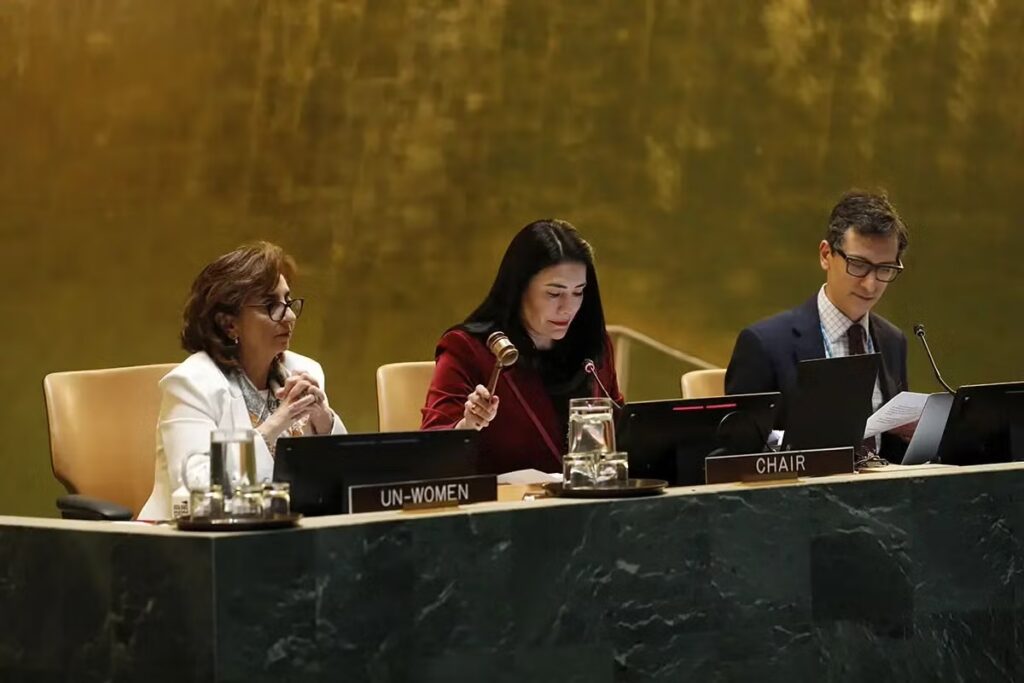
As the Chair of the Commission on the Status of Women, Ambassador Martiza Chan of Costa Rica said, following the agreed conclusions, how they’re adopted “depends on political will”.
“We came here to commemorate, and we’re leaving with something harder to carry – responsibility. Every woman who spoke to us today carried a single message: behind every statistic is a life, behind every negotiating position, is a woman or girl waiting to see if we mean what we say.”
But far too much time and energy were lost overall in the talks as delegations were forced to focus on preserving what had been gained, thanks to some key players who brought their own agendas.
Pictured above: Permanent Representative of Costa Rica to the United Nations and CSW70 Chair Maritza Chan Valverde gavels the adoption of the Agreed Conclusions, 9 March 2026. Photo: UN Women/Ryan Brown