
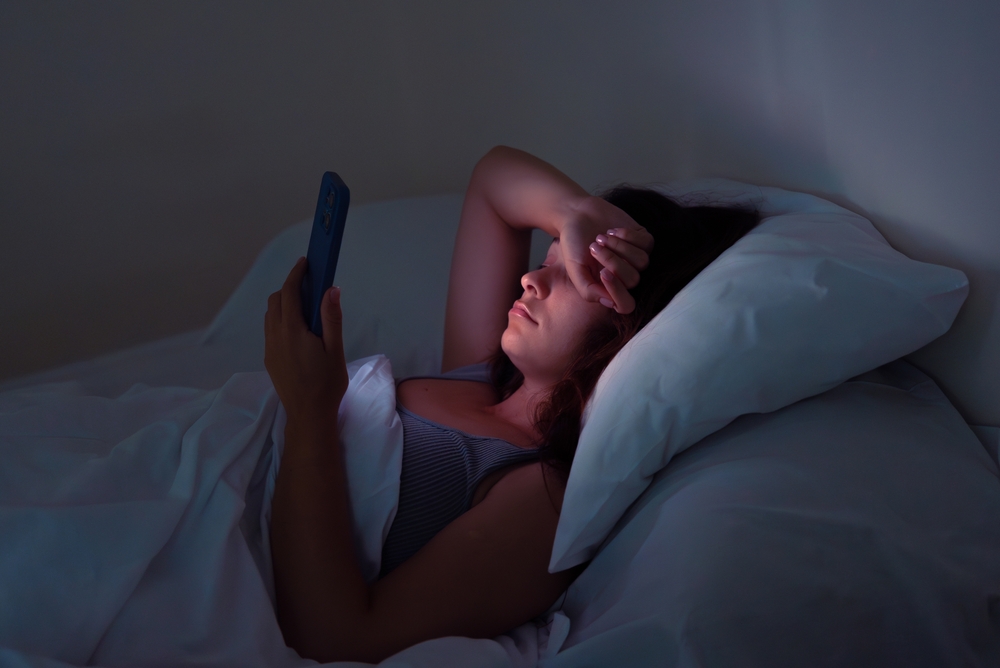
If you’ve ever felt dread creeping in as bedtime approaches or felt your heart rate pick up when you look at the clock at 2 am, you’re experiencing sleep anxiety.
It’s a specific feature of chronic insomnia, where the act of trying to sleep itself actually becomes a trigger for panic.
Your sympathetic nervous systemactivates, releasing cortisol and adrenaline, which are the exact opposite of what you need for sleep. The bed becomes a conditioned stimulus for heightened anxiety rather than relaxation.
What separates insomnia from occasionally poor sleep is this learned association.
People with insomnia show measurably increased activity in the brain regions involved in threat detection and worry specifically when attempting to sleep, which doesn’t happen in people without insomnia. Their brain has learned to treat sleep as something threatening that requires vigilant monitoring.
This is why insomnia maintains itself even after the original trigger (stress, illness, schedule disruption) has resolved.
Sleep restriction therapy
Sleep restriction therapy involves restricting your sleep window, allowing adenosine to build up faster during the time you’re awake, thus, promoting the onset of sleepiness. By shortening your time allowed for sleep, you’re creating genuine biological sleepiness that overrides the conditioned arousal response.
Your consistent wake time functions as what sleep researchers call a ‘zeitgeber’ (time-giver) for your circadian system. It tells your internal timekeeper (your SCN) when to orchestrate the daily release of melatonin and the drop in core body temperature that prepares you for sleep.
Meanwhile, the strict bed routine reconditions the stimulus-response association. Your brain stops pairing bed with anxious wakefulness and relearns that bed equals sleep. This reverses the classical conditioning that keeps insomnia stuck in place.
The sleep anxiety gradually diminishes, because you’re spending less time in bed awake, which means fewer opportunities for your brain to practise and reinforce the anxiety response. You’re essentially starving the learned association between bed and arousal.
How to regulate your sleep
Use the following steps if you need to regulate your sleep through sleep restriction.
- Establish baseline (1–2 weeks)
Track how long you’re actually sleeping (total sleep time, or TST) and your total time in bed (TIB) and work out your sleep efficiency (SE): Sleep efficiency (SE) = TST ÷ Time in bed × 100.
The US National Sleep Foundation recommends an SE of 85–90%.
- Set initial sleep window
Set your TIB to match your average TST. If you’re averaging 6 hours of actual sleep, that’s your starting time in bed.
Never go below 5.5 hours (this prevents dangerous daytime impairment).
- Anchor your wake time
Pick one wake time and treat it like a non-negotiable appointment. Same time every single day, weekends included.
This is what locks in your circadian rhythm.
- Calculate your bedtime
Work backwards from your wake time. Example: 6 am wake time – 6 hours TIB = midnight bedtime.
- Stick to your bedtime and wake time (no exceptions)
Only go to bed at your scheduled bedtime, even if you’re tired earlier.
Get up at wake time, no matter how rough the night was. No daytime napping (you need that sleep pressure to build).
If you’re not asleep within 15–20 minutes, get out of bed.
- Adjust your TIB weekly based on your SE
If your sleep efficiency is:
- Below 85% – cut 15–30 minutes off your TIB (go to bed later)
- 85–90% – Keep everything the same
- Above 90% – Add 15–30 minutes to your TIB (go to bed earlier)
- Keep going until sleep consolidates
You’re aiming for consistent sleep efficiency of 85–90% for at least 2 weeks, plus feeling reasonably functional during the day.
Then you can gradually extend towards a full 7–9 hours of sleep opportunity.
Setting realistic expectations
Sleep restriction doesn’t typically increase your total sleep time initially; that’s not the goal. The research confirms there is effect on total sleep time in the short term.
You’re trading fragmented, anxious sleep for solid, efficient sleep. The total duration catches up later, as you gradually extend your sleep window once efficient sleep is established.
Edited extract from Sleep First by Dr Jemma King (Wiley, $36.95), available 16 July at all leading retailers.